-
Titolo
-
Will she be queen of the sky?
-
Article Title and/or Image Caption
-
Will she be queen of the sky?
-
extracted text
-
WHEN the giant airship Hindenburg
exploded into flames at Lakehurst,
N. J., on the evening of May 6, 1937, many
people believed that it was the end of a |
noble experiment in lighter-than-air travel. |
It was, indeed, the end of an era in that
field. But a new era began soon after
Hitler's armies invaded Poland less than
two and a half years later. American air-
ships, nonrigid blimps, were drafted into
patrol duty along our coasts. Little was
said then about what those airships were
doing, and only a littie
more may be said to-
day about what they
have done. But it is
known that literally
hundreds of them have
piled up a log of hun-
dreds of thousands of
hours of strenuous
patrol and convoy
duty with a phenome-
nally low casualty
record.
On the basis of this
record, backed by an impressive mass of
figures and facts, American airship men are
now prepared to bid for a place in the
world’s postwar commercial aviation pro-
gram.
Anyone who looks at the over-all picture
of this air program will have trouble shrug-
ging off the airship. Its advocates offer—
and back with facts—many reasons for its
revival in world commerce. Chief among
the reasons are the airship’s speed and
safety, its economy of operation, its reli-
ability, and its load capacity. And Ameri-
cans can add this clincher: we have a
virtual world monopoly on helium, safest
known gas for inflating lighter-than-air
craft and clearly the key to successful
operation of airships.
It was the Germans who developed the
airship and proved its commercial worth.
Count Ferdinand von Zeppelin did his major
work of development before and during
World War I. Zeppelin, incidentally, made
his first flight here in America in 1863, in a
captive observation balloon of the Union
Army. He had come here as a military ob-
server, remained to fight for a time, and
returned to Germany before the Civil War
had ended.
During the years of trial and develop-
ment, nearly half a million passengers were
carried by airships without a single passen-
ger fatality until the Hindenburg fire. The
really significant figures come from the
records of the Graf Zeppelin and the Hinden-
burg, both built. specially for transoceanic
passenger and freight trade.
The Graf Zeppelin
made 590 commercial
flights totaling 17,177
hours and 1,053,618
miles. She made 144
ocean crossings and
carried more than 13,-
000 passengers and
250,000 pounds of mail
and freight. Her log
shows a flight to the
Arctic and one to
Egypt, and she circled
the globe. She was re-
tired without ever having had a serious
accident. | |
The Hindenburg, larger and more modern
than the Graf Zeppelin, was in service less |
than a year. But in that time she made 63
flights, 37 ocean crossings, was in the air |
3,088 hours, flew 209,527 miles, and carried |
more than 3,000 passengers and 41,000 |
pounds of mail and freight. |
American blimps also have a peacetime |
record well worth noting. Until they were |
taken over by the Navy, Goodyear’'s com- |
mercial blimps had made 152,441 flights |
totaling 93,096 hours and 4,166,390 miles. |
They had carried 407,171 passengers with- |
out so much as a minor injury to anyone. |
Military airships—that is, those rigid- |
framed dirigibles with which we and other
nations experimented for 15 years after |
1920—have had no such record of success. |
Five of those huge ships met destruction in |
tragic fashion, and the world still remem- |
bers them. Each of those disastrous acci-
dents, however, had its reason. |
In August 1921, the British ZR-2 broke in |
two and burned, causing a loss of 62 lives. |
‘The ZR-2 was a hydrogen-filled ship copied |
from a lightly built German “zep” captured
at the end of World War I; it was flown by
a crew unfamiliar with air stresses.
In December 1923, the French Dizmude
vanished over the Mediterranean with a
crew of 53 men. The Dizmude was a light-
weight, hydrogen-inflated German ship
seized after the armistice, and the French
crew was inexperienced.
In September 1925, the U. S. Navy's Shen-
andoah broke in two in a line squall near
Ava, Ohio, and 14 of her crew were lost.
The Shenandoah was a modified copy of a |
German ‘“zep” built in 1916, a touchy light-
weight in which it was suicidal to enter
any violent storm area.
In April 1933, the U.S. Navy's Akron
crashed into the sea off the New Jersey, coast
with a loss of 73 lives. She ran blindly into
a violent thunderstorm and, because of a
faulty altimeter, slammed her tail into the
waves while trying to maneuver out of the
storm.
In February 1935, the U. S. Navy's Macon
was forced down off the Pacific coast
and was lost. Two men died with her. She,
too, was fundamentally a sound ship. But
she was ordered to put out on fleet maneu-
vers before changes ordered in her aft struc-
ture had been completed, and she lost a fin
in a bit of rough weather. Subsequently, she
lost a good deal of gas and settled on the
ocean, where the waves ripped her to pieces.
Of these five military airships, only the
Akron and the Macon were even compara-
tively modern. Airmen who know what
happened insist that neither ship should
have been lost. Any sensible flyer goes
around a storm, not into it, and with today’s
aerology he knows when he is approaching
a storm area and how to avoid it. Both the
Graf Zeppelin and the Hindenburg met and
mastered such situations repeatedly. In
fact, the fate of these military airships
merely emphasizes the safety record of the
Graf Zeppelin and the Hindenbury.
In considering air travel, we naturally
think of speed. And in thinking of speed
over long distances, most of us turn in-
stinctively to the 350-miles-an-hour air-
plane. But over long distances, factors other
than maximum speed under ideal conditions
must be considered. There are layovers,
turn backs, delays, overnight stops. The
longer the trip, the more these factors
affect elapsed-time speed.
Rear Admiral Charles E. Rosendahl, prob-
ably America's most experienced airship
man, has compiled eye-opening figures on
comparative air speeds. He points out that
over a five-year period ending late in 1941
transpacific commercial planes on schedule
between San Francisco and Hong Kong
showed elapsed-time averages of about 35
miles an hour westward and 33 miles an
hour eastward. Bad-weather delays, circui-
tous routes, and overnight stops greatly
reduced actual flying time and increased
elapsed time.
Admiral Rosendahl's figures also show
that commercial air travelers bound across
the North Atlantic just before the present
war were taken in the winter months by a
roundabout southern route requiring an
average of four days and 16 hours per
passage. This, according to Admiral Rosen-
dahl's calculations, gave them an average
clapsed-time speed of only about 30 miles
an hour.
‘The only comparable airship figures are
those of the Graf Zeppelin and the Hinden-
burg. In 1928 the Graf Zeppelin made the
trip from Japan to San Francisco in 69
hours, at an average speed of nearly 75
miles an hour, elapsed time. The Hinden-
burg's average operational speed, also
elapsed time, was nearly 65 miles an hour
for all her ocean passages. The passenger-
plane schedule from San Francisco to Hong
Kong wes six days and seven hours. An
airship with the Hindenbury's average per-
formance would make the same trip in
about four and a half days.
The airships advantage here comes from
the fact that it does not have to make
Stops for refueling, that it can halt in mid-
air for motor repairs, that it has sufficient
range to go far around a bad-weather area
and can even seek a clear area and cruise
‘with only enough movement for steerageway
until bad weather ahead clears up. In fact,
the Hindenbury’s record shows that she
never falled to make a scheduled com-
mercial trip; she took of several times
|when the weather was so bad that all
airplanes were grounded; and she never
was more than 12 hours late on a scheduled
North Atlantic westward crossing or six
hours late on an eastward crossing. Also,
its ability to hover permits an airship to de.
lay its landing if that is necessary. Oncs,
warned by radio of a revolution, a German
airship postponed her landing at Recife,
Brazil, and merely headed into the wind for
two days.
+ For hauls of 1,000.to 2,000. miles the air-
ship cannot compete with the airplane in
speed, though it can offer stiff competition
in economy of operation. Passenger revenue
alone covered more than 75 percent of all
costs of operating the Hindenburg, including
amortization, and the ship never carried &
capacity load of paying passengers.
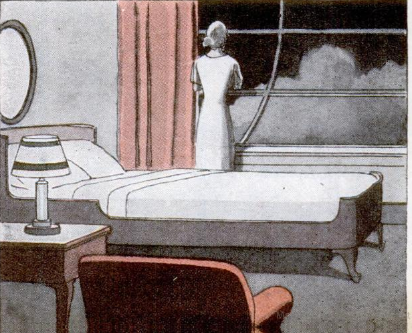
Passenger comfort is another notable
factor. The Hindenburg had 25 two-berth
staterooms, smoking and writing rooms,
promenades, three bars, and deck space
totaling an’ efghth of an acre. Her noise
level was rated at 61 decibels, lower even
than that of a Pullman car. There was not
enough vibration to ripple the surface of a
glasstul of water. And because of its size,
the airship absorbs the air bumps which
toss an airplane around to the discomfort of
its passengers. According to the records,
there never was a case of airsickness or
seasickness on elther the Graf Zeppelin or
the Hindenburg.
Can we build good airships? We built
two, the Akron and the Macon, both of
which were lost, according to findings of
official courts of Inquiry, because of opera-
tonal mistakes. Goodyear now han in blue-
print plans for a ship of 10,000,000 cubic
feet capacity, half again as largo as the
Macon and more than a third larger than
the Hindenburg. Tested designs are definite
Improvements on the best that the Germans
ever made. New materials made available
since the war began will permit still further
Improvement.
Professor J. C. Hunsaker of the Massa-
chusetts Instituto of Technology, a noted
‘aeronautical scientist, sees the transatlantic
services of the future falling into three cate-
goriea: a five-day steamship service, a one-
day airplane service, and a two-day airship
schedule.
“Consideration of the operating record of
the Hindenburg in North Atlantic service,”
he says, “leads to the conclusion that a sim-
flar airship of 28 percent greater displace-
ment should have a payload of 100 passen-
gers and 20,000 pounds of mail and express
When inflated with helium.”
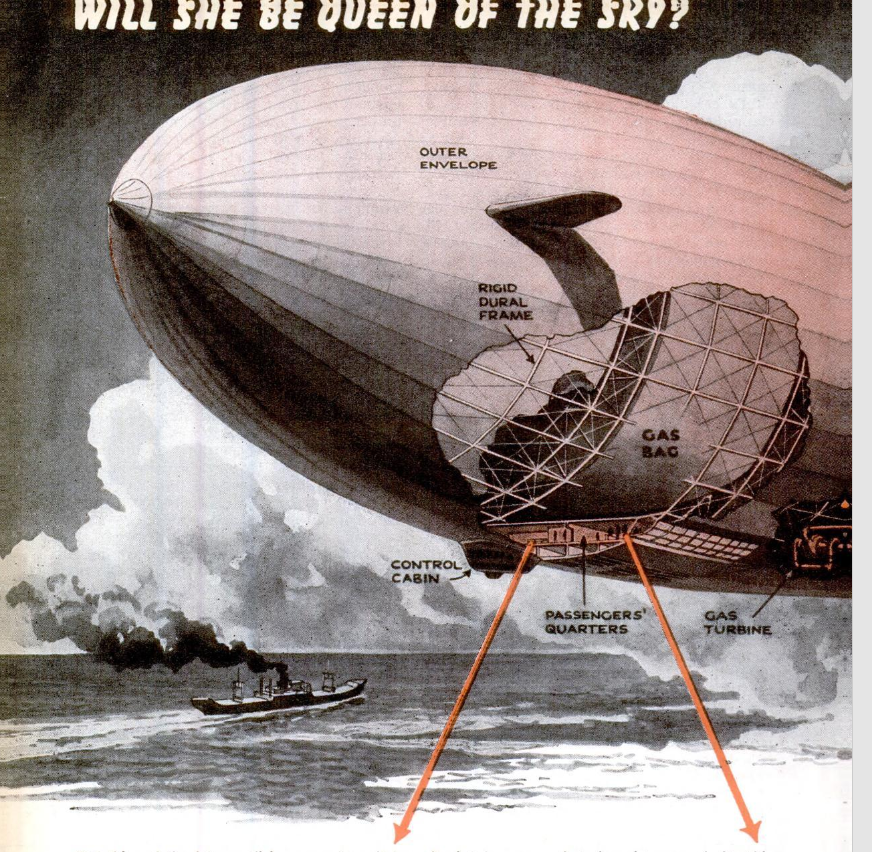
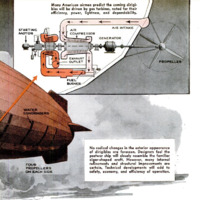
American designers were the first to move
the engines inboard to reduce drag, and to
swivel the propellers for better control. Now
it is suggested that both engines and pro-
pellers be placed in a central tunnel running
the length of the ship, which would further
reduce drag and improve control, and at the
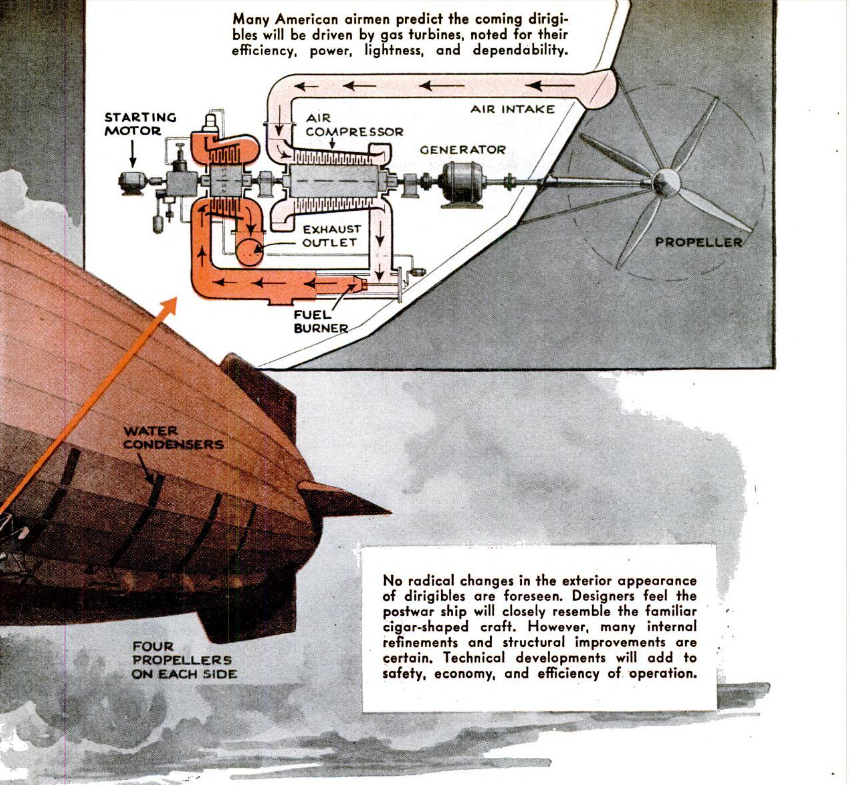
same time add a jet-propulsion effect. Also,
it seems likely that tomorrow's airships will
De using gas turbines for power, thus great-
ly increasing efficiency. These changes, ex-
perienced lighter-than-air authorities be-
lieve, could increase airship cruising speeds
to as much as 125 miles an hour.
As for costs, it is worth noting that our
whole military airship program up to 1941
cost less, for instance, than LaGuardia Field,
New York City’s airport. This included the
building of three rigid airships—the Shen-
andoah, the Akron, and the Macon—con-
struction of two airship docks and bases,
one on each coast, and five mooring masts,
one on a ship for sea moorings. This air-
ship program cost $30,000,000. LaGuardia
Field cost $42,000,000.
Finally, America’s monopoly on helium
makes an American airship program a
“natural.” Add to that the fact that its ship-
ment and storage are both complicated and
expensive, which means it probably will re-
main here. Helium has nearly 93 percent
as much lift as hydrogen, is an inert gas,
and is foolproof and virtually accident-
proof. Given capable handling, the weather
information now available, and intelligent
operation, American-built helium-filled air-
ships would seem to demand a place in any
international program of postwar com-
mercial aviation.
-
Lingua
-
eng
-
Data di rilascio
-
1945-05
-
pagine
-
129-135
-
Diritti
-
Public domain
-
Archived by
-
Sami Akbiyik
-
Marco Bortolami (editor)